Laws That Affected the Tenements
- Before 1867 there were absolutely no laws imposing responsibilities on slumlords to protect the health and safety of tenants.
- The Tenement House Act of 1867
- First Tenement Act of 1867
- Second Tenement House Act of 1879
- 1887 Amendment to the Second Tenement House Act
- New York Tenement Act of 1901
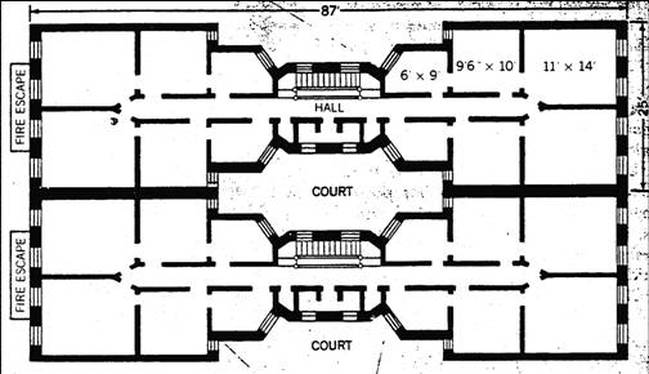
The result of the Second Tenement House Act of 1879
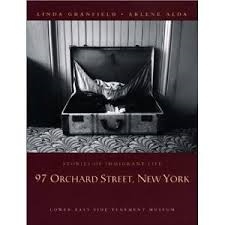
"No. 97 was not affected by the next round of tenement laws enacted in 1879. Only tenements built after that date had to meet its requirements: that all rooms have access to air. Since inner rooms had no way of facing the street or back yard, the law effectively required windows opening on air shafts. The result was the "dumbbell" tenements, so named because the indentations of the air shaft created a building footprint that resembles the shape of a dumbbell
weight." - Arnold Eagle, http://www.thirteen.org/tenement/eagle.html#lower
weight." - Arnold Eagle, http://www.thirteen.org/tenement/eagle.html#lower
"When these tenements were built, there were almost no laws regulating tenement construction. In the early 1860s, the laws mandated that there be a fire escape on a building, that it have a strong, fireproof party wall. But very little else was mandated, and even those rules that were on the books were largely ignored by owners because there was no way of making sure that these rules were followed."
- The Architecture and Development of New York, http://ci.columbia.edu/0240s/0243_2/0243_2_s1_text.html
- The Architecture and Development of New York, http://ci.columbia.edu/0240s/0243_2/0243_2_s1_text.html
